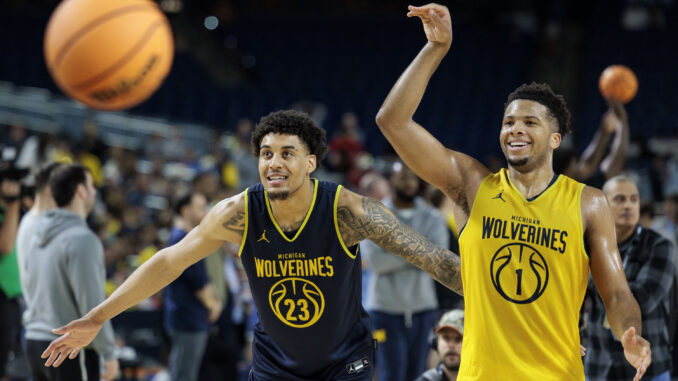
If Michigan can keep this backcourt together for next season, then the idea of a Final Four run—right there in Detroit—stops feeling like wishful thinking and starts looking like a very real possibility.
There’s something special about continuity in college basketball, especially in an era where roster turnover has become the norm. Teams that manage to hold onto their core, particularly in the backcourt, often gain an edge that goes beyond raw talent. It’s about chemistry, timing, trust, and the kind of unspoken understanding that only develops through shared minutes, tough losses, and big wins. Michigan’s guards have already shown flashes of that connection, and another year together could elevate them from promising to dominant.
What makes this backcourt so intriguing isn’t just their individual skill sets, but how naturally they complement each other. One brings pace and playmaking, the ability to break down defenses and create opportunities out of nothing. The other offers scoring punch, shot-making under pressure, and a calmness that settles the team in big moments. Together, they form a balance that’s incredibly difficult to defend. Opponents can’t key in on just one without the other making them pay.
Beyond the stat sheet, their growth trajectory is what should excite fans the most. Guards typically make their biggest leap between seasons once the game slows down mentally. Reads become quicker, decision-making sharpens, and confidence grows. If both players return, Michigan won’t just be getting the same version of them—they’ll be getting smarter, more efficient, and more complete leaders.
And leadership is where this really matters. Backcourts set the tone. They dictate tempo, control late-game situations, and often decide whether a team folds under pressure or rises above it. With another offseason to develop—not just physically, but vocally and emotionally—this duo could become the heartbeat of a team built to make a deep tournament run.
Now layer that potential onto the context of next season. The Final Four being held in Detroit adds a powerful narrative element. Playing effectively at home, in front of a crowd that would overwhelmingly be in their corner, creates an energy boost that can’t be overstated. College basketball thrives on momentum and environment, and few things are more motivating than the chance to play for a national championship in your own backyard.
But it’s not just about the story—it’s about the matchup advantages. Experienced guard play has historically been one of the most reliable predictors of March success. When games tighten up, when possessions matter more, and when defenses lock in, having guards who can create, control, and convert becomes invaluable. Michigan, with this backcourt intact, would check that box in a major way.
Of course, keeping them together is the key variable. Between professional aspirations and the ever-changing landscape of college basketball, nothing is guaranteed. Decisions will have to be made, and they won’t be easy ones. But if things align—if both players see the value in one more year, one more run, one more opportunity to build something special—then Michigan instantly becomes one of the most dangerous teams in the country.
There’s also a ripple effect to consider. When a strong backcourt returns, it stabilizes everything else. Incoming players can settle into roles more easily. The coaching staff can build more advanced schemes rather than starting from scratch. The offense flows better, the defense communicates more effectively, and the overall identity of the team becomes clearer from day one.
And let’s not ignore confidence. Teams that know they have elite guard play walk onto the floor with a different mindset. They expect to win close games. They believe they can handle pressure. That mentality often becomes the difference between teams that exit early and those that keep advancing.
So yes, it may sound bold right now. It may even feel a little premature. But college basketball history is filled with examples of teams that made the leap because they kept the right pieces together at the right time. Michigan has that opportunity sitting right in front of them.
If this backcourt returns, it won’t just be about running it back—it’ll be about leveling up. And with the Final Four set in Detroit, the stage couldn’t be more perfectly aligned.
Keep the guards, build around them, and suddenly the path to something special becomes a whole lot clearer.



Be the first to comment