Jim Courier names the player who could have ‘altered tennis history’ if not for injuries
In every era of professional tennis, there are players whose careers follow a clear, upward trajectory—rising through the ranks, capturing titles, and leaving behind a legacy defined by numbers. But there are also those rare talents whose stories are shaped not by what they achieved, but by what might have been. Former world No. 1 Jim Courier recently reignited that conversation by naming a player he believes could have altered the course of tennis history if injuries had not intervened.
Courier, a four-time Grand Slam champion and one of the sharpest minds in the sport today, did not make this statement lightly. Having competed against and analyzed some of the greatest players across multiple generations, he understands what separates a very good player from a truly transformative one. His choice speaks volumes—not just about raw talent, but about unrealized potential.
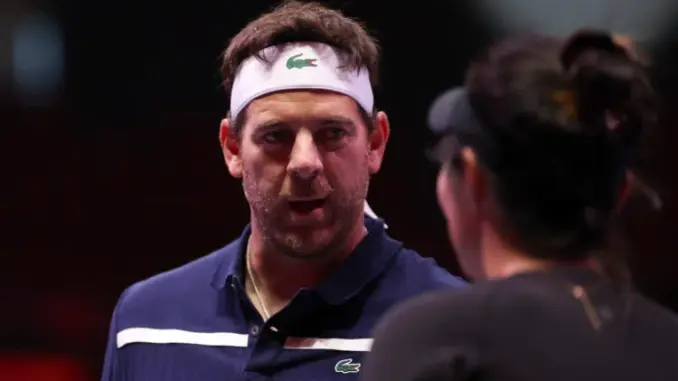
The player in question is Juan Martín del Potro, a name that still resonates deeply with tennis fans around the world. Standing at 6’6” with a thunderous forehand and surprising agility for his size, del Potro burst onto the scene as one of the most exciting young prospects of his generation. His crowning achievement came at the 2009 US Open, where he defeated both Rafael Nadal and Roger Federer in back-to-back matches to claim his first—and ultimately only—Grand Slam title.
At that moment, it seemed like the beginning of a new era. Federer and Nadal had dominated the sport, and Novak Djokovic was still ascending. Del Potro’s victory suggested a potential shift, a disruption to the established order. His power game, combined with mental composure well beyond his years, made him a genuine threat to the so-called “Big Three.”
But what followed was not a steady rise—it was a series of heartbreaking setbacks.
Injuries, particularly to his wrists, plagued del Potro’s career almost from the moment he reached the top. Multiple surgeries forced him off the tour for extended periods, disrupting his rhythm and robbing him of crucial years during his athletic prime. Each time he returned, he showed flashes of brilliance—reminding fans and analysts alike of what he was capable of—but the consistency required to dominate at the highest level was never fully restored.
Courier’s assertion that del Potro could have altered tennis history is rooted in this context. It’s not just about the matches he won, but the ones he never had the chance to play at full strength. During an era defined by three of the greatest players in history, breaking through was an almost impossible task. Yet del Potro proved, even in limited windows, that he could do exactly that.
His victories over top players were not flukes. They were authoritative, often overwhelming. His forehand was widely regarded as one of the most destructive shots in the game, capable of dictating rallies and dismantling even the most elite defenses. More importantly, he possessed the mental fortitude to compete on the biggest stages—something many talented players struggle to develop.
What makes Courier’s comment particularly compelling is the implication that del Potro’s presence at full strength could have disrupted the dominance of Federer, Nadal, and Djokovic. Tennis history over the past two decades has largely been defined by their rivalry, their records, and their sustained excellence. But what if there had been a consistent fourth force—someone capable of challenging them regularly, not just occasionally?
Would the Grand Slam count look different? Would certain rivalries have evolved in new directions? Would the narrative of tennis’s “golden era” include a broader cast of champions?
These are questions that cannot be answered definitively, but they highlight the significance of lost potential. Del Potro’s career serves as a reminder that greatness in sports is not solely determined by talent or determination. Timing, health, and circumstance play equally crucial roles.
Despite the setbacks, del Potro remains one of the most beloved figures in tennis. His resilience in the face of repeated injuries earned him admiration far beyond his results. Fans rallied behind him during each comeback, celebrating not just his victories, but his perseverance.
Courier’s reflection is, in many ways, a tribute. It acknowledges not only what del Potro achieved, but what he represented—a player capable of shifting the balance of power in one of the most competitive eras the sport has ever seen.
In the end, tennis history is written by those who stay healthy long enough to fulfill their potential. But it is also shaped by those who remind us how fragile that potential can be. Juan Martín del Potro belongs firmly in the latter category—a player whose impact was profound, even if his story feels incomplete.
And perhaps that is why Courier’s words resonate so strongly. They invite us to imagine an alternate history—one where injuries did not intervene, where talent had a clear runway, and where the trajectory of the sport might have been just a little bit different.



Be the first to comment