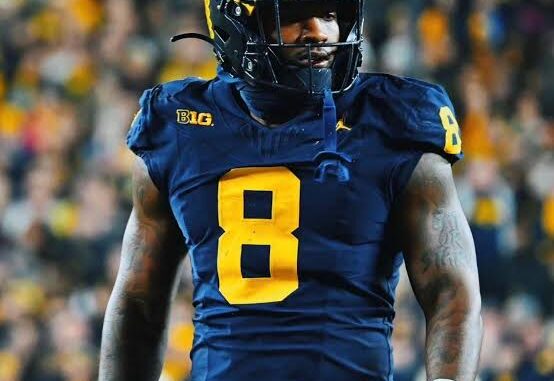
Derrick Moore Regret Having Contract With Michigan Wolverines
For many college athletes, committing to a powerhouse program is a dream come true. The prestige, the exposure, and the promise of development all combine into what feels like the perfect opportunity. But for Derrick Moore, what once looked like a golden path has become a complicated and, at times, frustrating journey filled with second thoughts and lingering questions.
When Moore first signed his contract with the Michigan Wolverines, expectations were sky-high. He was seen as a rising defensive talent, someone who could thrive under the program’s disciplined structure and competitive culture. Michigan, with its storied history and national recognition, seemed like the ideal place to sharpen his skills and prepare for a future in professional football. At the time, the decision felt obvious—almost inevitable.
However, reality has a way of diverging from expectations.
Since joining the Wolverines, Moore has faced challenges that go beyond the physical demands of the game. Adjusting to the system, competing for limited playing time, and navigating the pressures of a high-profile program have all played a role in shaping his experience. While competition is a natural part of elite college football, it can also expose cracks in confidence and raise doubts about whether a different environment might have been more suitable.
Reports and observations suggest that Moore has not always found himself in the position he envisioned when he signed. Whether it’s limited snaps on game day or difficulties fitting into specific defensive schemes, the gap between expectation and reality has been hard to ignore. For an athlete driven by growth and impact, feeling underutilized can be deeply frustrating.
There’s also the broader issue of fit—something that doesn’t always get enough attention during recruitment. A program may be successful overall, but that doesn’t guarantee it’s the best place for every individual player. Style of play, coaching philosophy, and even locker room dynamics can significantly affect an athlete’s development and satisfaction. In Moore’s case, it’s becoming increasingly clear that the alignment may not be as strong as initially believed.
Another layer to this situation is the evolving landscape of college football. With the transfer portal and NIL (Name, Image, and Likeness) opportunities reshaping how athletes approach their careers, players now have more flexibility—and more pressure—than ever before. Decisions are no longer just about loyalty or tradition; they’re strategic moves that can influence long-term success. For someone like Moore, this adds weight to every moment spent questioning whether he made the right choice.
It’s important to note that regret in this context doesn’t necessarily mean failure. Rather, it reflects the complexity of high-level athletic decisions. Moore is still a talented player with potential, and his journey is far from over. But acknowledging dissatisfaction is often the first step toward change, whether that means adapting within the program or exploring new opportunities elsewhere.
Fans and analysts alike have begun to speculate about what comes next. Will Moore remain committed to Michigan and fight for a larger role? Or will he consider entering the transfer portal in search of a better fit? Both paths come with risks. Staying requires patience and resilience, while leaving involves uncertainty and the challenge of starting over in a new system.
What makes Moore’s situation particularly compelling is how relatable it is, even beyond sports. Many people have experienced committing to something—a job, a school, a path—only to realize later that it might not align with their goals or strengths. The difference is that Moore’s journey is playing out on a public stage, where every decision is scrutinized and every performance analyzed.
Ultimately, the story of Derrick Moore and his contract with the Michigan Wolverines is still being written. Regret, if it exists, is only one chapter. What matters most is how he responds to it. Will he use it as motivation to prove himself within the program, or as a catalyst to seek a new direction?
In the high-stakes world of college football, there are no easy answers. But one thing is certain: decisions like these shape not just careers, but character. And for Derrick Moore, the next move could define both.

Be the first to comment