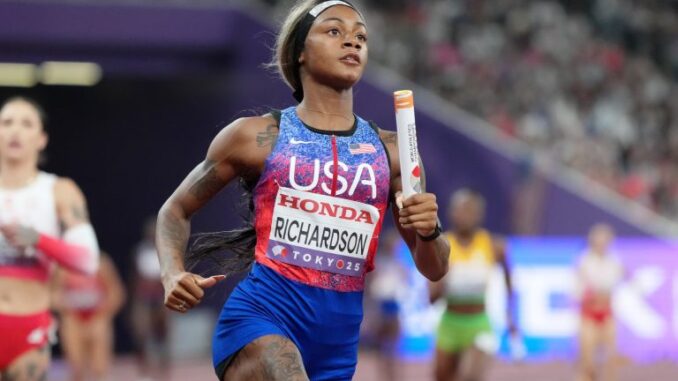
When two generations of sprinting excellence cross paths, the moment carries more than just nostalgia—it becomes a powerful bridge between eras, cultures, and the enduring spirit of competition. That’s exactly what unfolded when American sprint sensation Sha’Carri Richardson met Australian legend Cathy Freeman, a meeting that quickly captured the imagination of track and field fans around the world. Their connection went beyond admiration; it was rooted in a shared triumph at one of Australia’s most historic athletic events—the Stawell Gift.
The Stawell Gift, held annually in Victoria, is no ordinary race. With its unique handicap format and rich legacy dating back to the 19th century, it has long been a proving ground for both emerging talents and established stars. Winning there requires more than speed—it demands strategy, composure, and the ability to perform under intense pressure. For both Richardson and Freeman, their victories at Stawell represent defining moments in their respective careers, making their meeting all the more meaningful.
Sha’Carri Richardson, known for her electrifying speed and unapologetic personality, has become one of the most recognizable figures in modern athletics. Her journey has been anything but conventional, marked by both dazzling victories and deeply human setbacks. Yet through it all, she has remained resilient, using each experience to fuel her growth. Her win at Stawell added another layer to her evolving legacy, showcasing her adaptability and willingness to embrace challenges beyond the traditional track circuit.
Cathy Freeman, on the other hand, is a name etched in sporting history. Best known for her iconic 400-meter gold medal at the Sydney 2000 Olympics, Freeman carried not only the hopes of a nation but also the pride of Indigenous Australians. Her victory remains one of the most celebrated moments in Olympic history, symbolizing unity, perseverance, and the power of representation. Long before and after that historic race, Freeman’s impact extended far beyond the track, inspiring generations of athletes worldwide.
When Richardson and Freeman met, it was more than a simple exchange of pleasantries—it was a meeting of kindred spirits. Both athletes understand the weight of expectation and the scrutiny that comes with being in the spotlight. Both have navigated the complexities of identity, representation, and resilience in their own unique ways. And both have found themselves standing atop the podium at Stawell, a shared experience that instantly created a bond between them.
Images and clips from their meeting quickly spread across social media, showing genuine warmth and mutual respect. Richardson, often seen as bold and outspoken, appeared reflective and appreciative in Freeman’s presence. Freeman, ever graceful and composed, welcomed Richardson with the quiet confidence of someone who has walked a similar path. Their interaction felt less like a passing moment and more like a symbolic passing of the torch—an acknowledgment of how far the sport has come and where it is headed.
What makes this encounter particularly compelling is the contrast in their eras. Freeman competed in a time when global media was less immediate, where moments lived primarily through television broadcasts and newspaper headlines. Richardson, by contrast, exists in the digital age, where every race, reaction, and remark is instantly shared and dissected online. Yet despite these differences, their core experiences as elite athletes remain strikingly similar: the relentless pursuit of excellence, the pressure to perform, and the desire to leave a lasting impact.
Their shared Stawell victories serve as a reminder of the event’s unique place in athletics. It is a stage where legends are honored and new stars are born, where tradition meets innovation. For Freeman, winning at Stawell was another milestone in an already illustrious career. For Richardson, it represented an opportunity to connect with a different facet of the sport and to etch her name into a storied history.
Beyond the track, their meeting also highlights the importance of mentorship and representation in sports. Seeing two powerful women from different backgrounds and generations come together sends a strong message to young athletes everywhere: greatness is not confined to one era, one style, or one narrative. It evolves, adapts, and continues to inspire.
As fans reflect on this moment, it’s clear that the significance goes far beyond a single meeting. It’s about continuity—the way one athlete’s legacy can influence another’s journey. It’s about respect—the acknowledgment of those who paved the way. And it’s about possibility—the idea that the next generation can build upon what came before while forging their own path.
In the end, the meeting between Sha’Carri Richardson and Cathy Freeman wasn’t just a highlight reel moment—it was a celebration of athletic excellence, shared achievement, and the timeless spirit of competition. Their connection, rooted in Stawell and strengthened by mutual admiration, stands as a testament to the enduring power of sport to unite, inspire, and transcend generations.
Be the first to comment