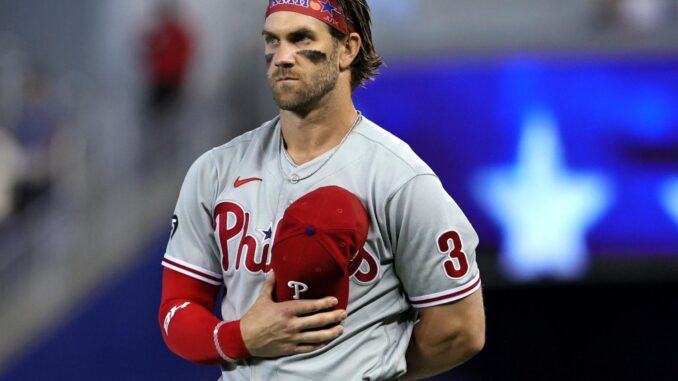
Bryce Harper Revives Dave Dombrowski Dispute With ‘Not Elite’ Shirt
Bryce Harper has never been one to shy away from confrontation, symbolism, or statements that blur the line between competitive fire and personal conviction. Over the years, the Philadelphia Phillies superstar has built a reputation not only as one of Major League Baseball’s most recognizable talents, but also as a player who wears his emotions proudly—sometimes literally. That reputation was reignited recently when Harper appeared wearing a bold “Not Elite” shirt, a phrase that instantly stirred memories of a long-simmering dispute involving Phillies president of baseball operations Dave Dombrowski.
The shirt may have looked simple at first glance, but within baseball circles, it landed like a thunderclap.
The Roots of the “Not Elite” Label
To understand the significance of Harper’s shirt, one must revisit comments that have lingered in the background of Phillies discourse for years. Dave Dombrowski, a veteran executive known for his championship pedigree with teams like the Boston Red Sox and Detroit Tigers, has long been outspoken about roster construction, analytics, and what separates “good” teams from “elite” ones. In past interviews, Dombrowski used the word elite carefully—sometimes controversially—when describing players, organizations, and competitive standards.
While Dombrowski never publicly labeled Bryce Harper himself as “not elite” in a direct insult, remarks about team identity, payroll efficiency, and performance benchmarks were widely interpreted as subtle critiques during moments when the Phillies, despite having star power, fell short of championship expectations. For a player like Harper—who signed a historic contract, embraced Philadelphia wholeheartedly, and delivered MVP-level performances—those undertones clearly struck a nerve.
Harper’s Shirt as a Statement
Harper’s decision to wear a “Not Elite” shirt wasn’t random fashion. It was calculated, pointed, and deeply symbolic. In modern sports culture, athletes often use clothing to express defiance, unity, or protest, and Harper has mastered that language. The shirt functioned as both irony and challenge—an acknowledgment of criticism paired with a refusal to accept it.
By reclaiming the phrase, Harper effectively flipped the narrative. Rather than allowing “not elite” to exist as a label imposed from above, he turned it into a badge of motivation. The message was clear: if this is what doubters think, then let performance do the talking.
A Complicated Relationship With Management
The Harper–Dombrowski dynamic reflects a broader tension seen across professional sports: the clash between player identity and executive philosophy. Dombrowski is a results-driven architect, focused on championships above sentiment. Harper, meanwhile, represents the emotional core of the Phillies—an athlete who feeds off respect, loyalty, and belief.
While the two share the same organizational goal, moments like this reveal underlying friction. Harper’s shirt suggested that old comments still resonate, even after playoff runs and deep October baseball. It raised questions about communication within the organization and whether star players always feel fully validated by leadership, regardless of public praise.
Fan Reaction and Media Buzz
Unsurprisingly, the shirt ignited social media and sports talk shows almost instantly. Phillies fans largely rallied behind Harper, interpreting the gesture as proof of his passion and refusal to settle. Many applauded him for standing up to perceived disrespect, especially from the front office.
Others, however, questioned whether reviving old disputes was necessary. Critics argued that internal unity is crucial for sustained success and that subtle public shots—even symbolic ones—can create distractions. Yet even those voices acknowledged one thing: Bryce Harper knows exactly how to command attention.
Performance as the Ultimate Answer
What makes Harper’s statement particularly compelling is his track record of backing up words with action. Since joining the Phillies, he has delivered MVP-caliber seasons, clutch postseason moments, and leadership that transformed the clubhouse culture. He has played through injuries, changed positions for the team’s benefit, and consistently embraced the pressure that comes with being the face of the franchise.
In that context, the “Not Elite” shirt feels less like bitterness and more like fuel. Harper thrives on proving people wrong, and history suggests that perceived slights often sharpen his edge rather than dull it.
The Broader Meaning in Today’s MLB
Harper’s move also highlights a shift in how modern athletes engage with power structures. Players today are more vocal, brand-aware, and willing to push back against narratives set by executives or analysts. Clothing, social media, and subtle gestures have become tools of expression, allowing athletes to speak without holding a press conference.
In that sense, the shirt transcends the Harper–Dombrowski relationship. It reflects a league where star players increasingly demand acknowledgment not just for statistics, but for impact, leadership, and identity.
Where the Phillies Go From Here
Whether Dave Dombrowski responds publicly or chooses silence, the moment has already made its mark. Internally, it may prompt reflection about messaging and mutual respect. Externally, it reinforces Bryce Harper’s image as a competitor who internalizes everything—and forgets nothing.
Ultimately, the success of the Phillies will determine how this episode is remembered. If the team continues to contend, the shirt will be seen as part of Harper’s relentless drive. If struggles emerge, critics may frame it as unnecessary drama. Either way, Harper has once again reminded the baseball world that labels don’t define him—performance does.
Final Thoughts
Bryce Harper’s “Not Elite” shirt was more than apparel; it was a narrative device, a psychological jab, and a declaration of self-belief. By reviving echoes of his dispute with Dave Dombrowski, Harper turned criticism into conversation and conversation into motivation. Love him or question him, one thing remains undeniable: Bryce Harper refuses to be quietly categorized. And in Philadelphia, that defiance often feels exactly right.

Be the first to comment