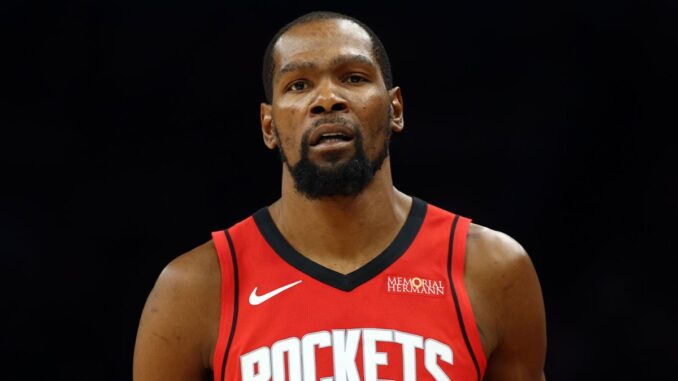
Kevin Durant lands on the Rockets’ injury report before a highly anticipated clash, and it’s already shifting the tone around what was supposed to be a statement night.
There’s a particular kind of energy that follows Durant into any arena — a mix of expectation, curiosity, and inevitability. Fans don’t just watch him play; they anticipate moments. The pull-up jumper over a double team. The quiet takeover in the fourth quarter. The effortless reminder that, on any given night, he’s still one of the most unguardable players in basketball. So when his name appears on an injury report, even with something minor attached, it doesn’t just register — it lingers.
The Rockets, a team still carving out its identity amid a blend of youth and ambition, were gearing up for a measuring-stick game. Matchups like this are less about the final score and more about validation. How do you handle greatness? How do you respond when the spotlight sharpens and the opponent carries a different level of weight? Durant’s presence alone changes those answers.
Now, there’s uncertainty.
Injuries in the NBA exist on a spectrum — from routine maintenance listings to genuine concerns that alter rotations and outcomes. At this stage, it’s unclear exactly where Durant’s situation falls. Teams are increasingly cautious, especially with veteran stars whose long-term availability matters more than any single regular-season contest. But even a hint of limitation raises questions. Will his minutes be restricted? Will he play at all? And if he does, will he be the same version that demands immediate defensive adjustments?
For Houston, this creates a strange kind of dilemma. On one hand, a potentially limited Durant could tilt the competitive balance in their favor. On the other, there’s an unspoken desire — especially among younger players — to test themselves against the best at full strength. You don’t grow by facing watered-down versions of greatness. You grow by being challenged by it.
Still, the NBA doesn’t pause for ideal scenarios.
If Durant is sidelined or clearly not at 100 percent, it forces others to step into a vacuum that doesn’t easily get filled. Star players don’t just contribute points; they shape defensive schemes, dictate pace, and absorb pressure. Remove that, and the entire ecosystem of a game shifts. Teammates take on roles they might not be fully comfortable in. Opponents adjust strategies, sometimes overcorrecting in ways that create unexpected openings.
And then there’s the psychological layer.
Durant has spent years building a reputation not just as a scorer, but as a stabilizer — someone who can quiet a run, reset momentum, and impose order when games start to slip. When that element is potentially compromised, even slightly, it introduces doubt. Not panic, not collapse — but just enough uncertainty to matter at the highest level.
For fans, it’s another reminder of the delicate balance between performance and preservation. The modern NBA is as much about longevity as it is about peak moments. Players like Durant aren’t just judged on what they do tonight, but on how available they remain deep into the season and beyond. Every decision — to play, to rest, to push through discomfort — carries implications that extend far past a single matchup.
Yet, there’s also intrigue here.
Because sometimes, situations like this produce unexpected narratives. A younger player steps up. A role player delivers a career night. A team that was supposed to be overshadowed finds its voice. The absence — or limitation — of a star doesn’t just subtract from a game; it reshapes it.
For the Rockets, this could be an opportunity disguised as disruption. How do they respond to shifting expectations? Do they press an advantage if Durant is limited, or do they lose focus without the clarity of facing a full-strength opponent? Growth in the NBA isn’t always linear, and it rarely arrives in perfectly packaged moments.
As for Durant, the situation reinforces something that has followed him throughout his career — the constant tension between brilliance and fragility. Not fragility in terms of skill, but in the physical demands placed on a body that has carried so much offensive responsibility for so long. Every appearance on an injury report becomes part of that broader conversation, whether fair or not.
And so, as tip-off approaches, the story isn’t just about whether he plays. It’s about how his status influences everything around him — the strategies, the mindset, the rhythm of the game itself.
Because when a player like Durant is involved, even uncertainty becomes a headline.
Whatever happens next, one thing is certain: all eyes will be watching, not just for the result, but for what it reveals.

Be the first to comment