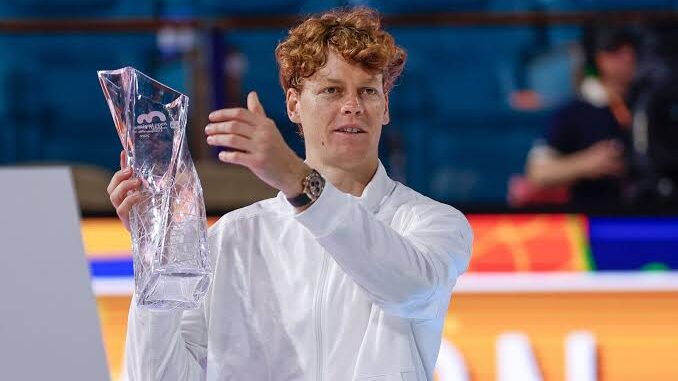
“Ridiculous” — Jannik Sinner’s Nearly $1.2 Million Miami Open Cheque Sparks Backlash from John Isner and Others
The tennis world is once again caught in a familiar debate—money, fairness, and the ever-growing gap between the sport’s top earners and everyone else. This time, the spotlight is on Jannik Sinner, whose nearly $1.2 million winner’s cheque from the Miami Open has triggered sharp criticism, including a blunt reaction from former American pro John Isner, who summed it up in one word: “ridiculous.”
Sinner, who has been in sensational form and continues to cement his place among tennis’s elite, walked away with the lion’s share of the prize pool after an impressive run at the prestigious Miami Open. While his performance on the court has been widely praised, the size of his earnings has ignited a broader conversation about prize money distribution in professional tennis.
John Isner, known for his outspoken takes even after stepping away from full-time competition, didn’t hold back. His criticism wasn’t necessarily directed at Sinner himself, but rather at the structure of prize money allocation in tournaments. According to Isner and others who share his view, the issue lies in how heavily the rewards are skewed toward champions, leaving lower-ranked players fighting for financial survival despite competing in the same events.
The nearly $1.2 million payout has become a symbol of what some see as a growing imbalance. While top-tier players like Sinner, Novak Djokovic, and Carlos Alcaraz routinely earn massive sums through prize money and endorsements, those ranked outside the top 50—or even top 100—often struggle to cover travel, coaching, and training expenses. For them, early-round exits can mean financial losses rather than gains.
Critics argue that tennis, unlike team sports with guaranteed contracts, places an enormous burden on individual players. Every match matters not just for ranking points but for livelihood. When a single player earns such a large percentage of the prize pool, it raises questions about whether the system adequately supports the broader player base.
Supporters of the current structure, however, see things differently. They argue that elite players drive the sport’s popularity, attract sponsorships, and fill stadiums. From this perspective, it makes sense that winners—those who deliver the most compelling performances and ultimately claim titles—receive the biggest rewards. After all, high stakes and significant payouts are part of what makes professional sports so captivating.
Sinner himself has not been at the center of the criticism in a personal sense. Most observers agree that he earned every dollar through his performance. The Italian star has been one of the most consistent and exciting players on tour, showcasing not only technical brilliance but also mental toughness. His victory in Miami further reinforces his status as a leading figure in the next generation of tennis.
Still, the conversation sparked by his prize money reflects deeper structural questions. Should tournaments distribute winnings more evenly across all rounds? Would a more balanced system help sustain the careers of lower-ranked players and make the sport more competitive overall? Or would it dilute the incentive and prestige associated with winning major titles?
This isn’t the first time such concerns have surfaced. Over the years, players and analysts have repeatedly pointed out the financial disparities within the sport. The COVID-19 pandemic, which disrupted tournaments and reduced earning opportunities, only intensified these discussions. Some reforms have been introduced at various levels, but many believe they don’t go far enough.
Isner’s comments have resonated with a segment of the tennis community that feels the issue is long overdue for serious attention. Social media reactions have echoed similar sentiments, with fans and players debating whether the current model is sustainable in the long term.
On the other hand, there’s also a strong argument that tennis operates on a merit-based system, where rewards are directly tied to performance. In such a framework, the winner taking a substantial prize is not only expected but necessary to maintain the competitive spirit of the sport.
As the debate continues, one thing is clear: Sinner’s Miami Open cheque has become more than just a paycheck—it’s a flashpoint in an ongoing discussion about fairness, economics, and the future of professional tennis.
Whether this moment leads to meaningful change remains to be seen. For now, it serves as a reminder that behind the glamour of championship trophies and million-dollar prizes lies a complex ecosystem, where not all players share equally in the rewards.
And as voices like Isner’s continue to challenge the status quo, the pressure on governing bodies to address these concerns is unlikely to fade anytime soon.



Be the first to comment